Press Release 29/05/2025
SURVEY ON THE STRUCTURE OF AGRICULTURAL HOLDINGS. 2023
Further consolidation of agricultural holdings in the Basque Country between 2020 and 2023: there were 19% fewer holdings, but their average area was up 21.6%
Almost a third of holdings were run by women
The number of agricultural holdings in the Basque Country stood at 10,440 in 2023, according to Eustat’s Survey on the Structure of Agricultural Holdings, down 19.2% from the figure recorded in the 2020 Agricultural Census. Compared to the previous survey conducted in 2016, there was a cumulative decrease of 32.9%, reflecting the ongoing process of consolidating holdings.
In 2023, the total utilised agricultural area (UAA) was 177,011 hectares, slightly lower than in 2020 (-1.8%). Given the sharp drop in the number of holdings, the average UAA per holding increased significantly to stand at 17.0 hectares, up 21.6% on the average for 2020 and almost 50% higher than in 2016.
Number of farms and agricultural area of the Basque Country by type of exploitation. 2016-2023
| | 2023 | 2020 | Increase 2023-2020 (%) | 2016 | Increase 2023-2016 (%) |
| | | | | | |
| Number of agricultural holdings | 10.440 | 12.919 | -19,2 | 15.564 | -32,9 |
| | | | | | |
| Total area (TA) | 219.264 | 225.948 | -3,0 | 249.042 | -12,0 |
| | | | | | |
| Used agricultural surface area (SAU) | 177.011 | 180.196 | -1,8 | 176.319 | 0,4 |
| -Tilled land | 84.805 | 81.392 | 4,2 | 74.167 | 14,3 |
| - Herbaceous and fallow (*) | 65.708 | 63.100 | 4,1 | 59.104 | 11,2 |
| - Fruit trees | 2.400 | 2.863 | -16,2 | 1.420 | 69,0 |
| - Olive tree | 213 | 212 | 0,5 | 183 | 16,4 |
| - Vineyard | 15.996 | 14.470 | 10,5 | 13.338 | 19,9 |
| - Other permanent carpenters | 488 | 747 | -34,7 | 122 | 300,0 |
| PERMANENT GRAZING | 92.206 | 98.804 | -6,7 | 102.148 | -9,7 |
| | | | | | |
| Structural indicators | | | | | |
| Average land area per holding (TA) | 21 | 17 | 20,1 | 16 | 31,3 |
| Average UAA per holding | 17 | 14 | 21,6 | 11 | 49,7 |
(*)includes orchards for self-consumption
Date May 29, 2025
Source: Eustat. Survey on the Structure of Agricultural Farms
By province, there were marked structural differences. Álava accounted for 61% of the UAA in the Basque Country, with an average holding size well above the average (35.5 ha). In Bizkaia and Gipuzkoa, on the other hand, the average area per holding was 9.7 and 8.9 hectares, respectively. However, the rate of decline in the number of holdings was steep in all three provinces, leading, in all cases, to an increase in average size compared to previous years.
Number of farms and useful agricultural area (SAU) of the Basque Country by historical territory. 2023-2020
| | 2023 | 2020 |
| | Nº farms | SAU | medium SAU | Nº farms | SAU | medium SAU |
| Basque Country | 10.440 | 177.011 | 17,0 | 12.919 | 180.196 | 13,9 |
| Araba/Álava | 3.051 | 108.388 | 35,5 | 3.352 | 107.012 | 31,9 |
| Bizkaia | 3.362 | 32.732 | 9,7 | 4.651 | 35.073 | 7,5 |
| Gipuzkoa | 4.026 | 35.891 | 8,9 | 4.916 | 38.111 | 7,8 |
Date May 29, 2025
Source: Eustat. Survey on the structure of agricultural farms
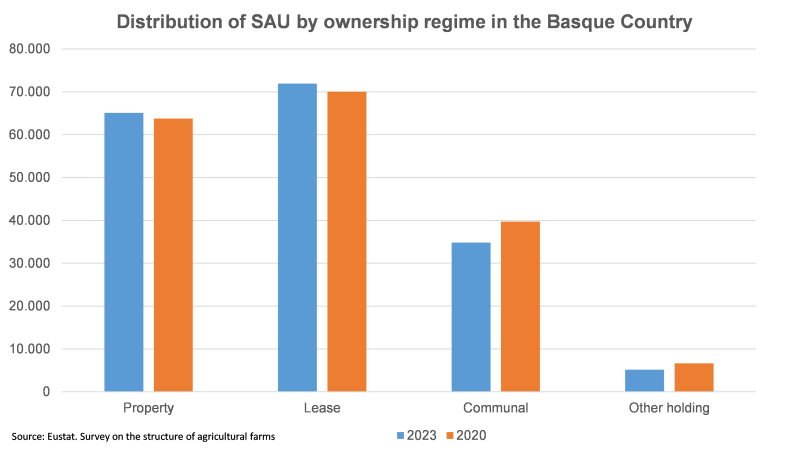
As regards land tenure, the majority of the UAA (41%) was rented, followed very closely by land owned by the holders (37%). The remainder corresponded to communal areas or areas under other types of tenure. These proportions were similar to those seen in 2020, although there was a slight increase in the rental of land, in line with the gradual withdrawal from activity due to the advanced age of the holders.
The type of farming on Basque holdings also revealed provincial characteristics. In Álava, vineyard holdings predominated, accounting for 44% of holdings in the province. Another 20% of holdings corresponded to those specialised in major crops (cereals, oilseeds and pulses), due to the province’s large amount of flat agricultural land. Bizkaia and Gipuzkoa, on the other hand, stood out in terms of holdings used for mountain livestock farming, specifically sheep, goats and other grazing livestock, which represented 32% and 40% of their holdings, respectively. This diversity reflects the climatic and orographic differences within the Basque Country.
Farm management
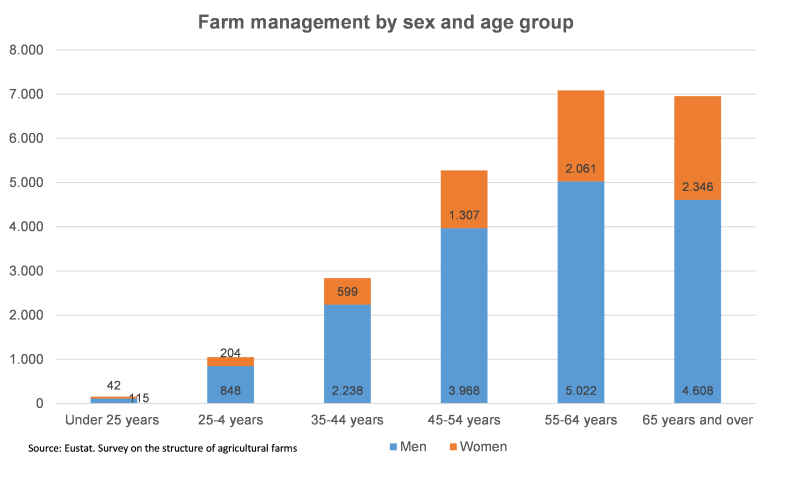
Nearly one in three agricultural holdings (31%) in the Basque Country were managed by a woman, 5 points more than in 2020
As regards the holders of holdings (natural or legal persons, owners or renters, who assume legal and economic responsibility for a holding and are responsible for making decisions), the vast majority (89%) were natural persons, while 11% were managed by legal persons (trading companies, civil companies, etc.). 93% of holdings that were not incorporated as a company were held by a single natural person, with the holder themselves running the holding in more than 95% of cases. This leaves 7% of holdings that were jointly held by several natural persons, most of whom were couples.
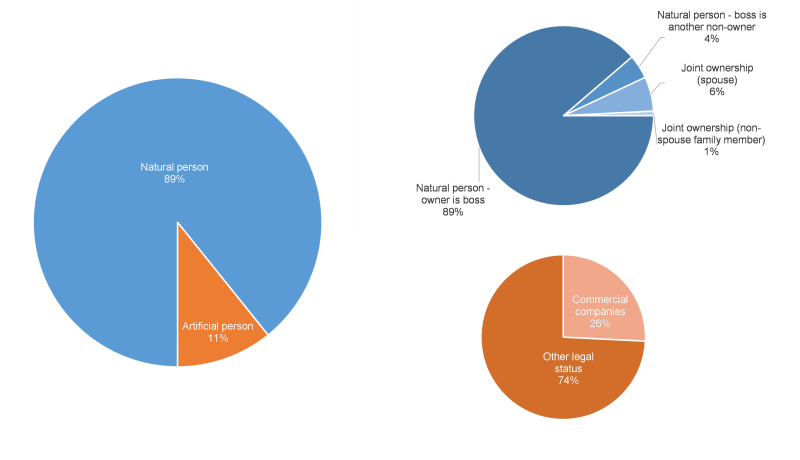
The manager of the holding is the natural person responsible for the normal daily financial and production activities of the agricultural holding. In 2023, 31% of holdings had a female manager, compared to 26% in 2020, which shows an increase in women’s involvement in the management of holdings. This means that nearly one in three holdings were run by a woman. The average age of holding managers was 57.6 years old. It is worth highlighting that female managers were slightly older than their male counterparts by approximately 3 years. Significant ageing could also be seen: almost 29% of holding managers were aged 65 or over. Just 5% of managers were under 35 years of age. These figures highlight the ongoing challenge of generational replacement within the Basque agricultural sector.
Agricultural labour force
Álava accounted for more than half of paid work, while Bizkaia and Gipuzkoa relied more on the family labour force
The total amount of work carried out on Basque agricultural holdings in 2023 was equivalent to 12,175 Annual Work Units (AWUs), taking into account both the family and non-family labour force. This volume of work represented a slight decrease in respect of 2020 (when the estimated number of AWUs stood at around 14,000). On average, each holding required 1.17 AWUs in 2023, compared to approximately 1.09 AWUs per holding in 2020, indicating a higher workload concentrated in fewer production units.
We can see that Álava provided more than half of the non-family labour force in the Basque Country (1,991 AWUs, 58% of all non-family labour), reflecting a greater presence of paid workers on larger, more business-oriented holdings. In effect, in Álava, non-family labour accounted for 47% of the province’s AWUs, a much higher percentage than in Bizkaia (18%) or Gipuzkoa (19%). In the latter two provinces, holdings relied on labour performed by the holder and their family, which represented more than 80% of the AWUs, due to the smaller scale and generally part-time nature of many holdings.
Annual work units of the farms of the Basque Country by historical territory. 2023
| | Basque Country | Araba/Álava | Bizkaia | Gipuzkoa |
| Total labor | 12.175 | 4.243 | 3.495 | 4.438 |
| Labor: Headline | 5.745 | 1.774 | 1.747 | 2.224 |
| Labor: Family of the Holder | 2.973 | 478 | 1.128 | 1.367 |
| Labour: Not belonging to the family of the holder | 3.457 | 1.991 | 619 | 847 |
Date May 29, 2025
Source: Eustat. Survey on the structure of agricultural farms
Irrigation on the holding
Álava accounted for 83% of irrigable land in the Basque Country, and 89% of irrigable land was actually irrigated
Irrigable land is land that could be irrigated using the equipment and facilities available on the holding (regardless of whether or not it has been irrigated in the reference period). In 2023, there were 4,553 holdings equipped with irrigation facilities. Álava accounted for 83% of irrigable land (5,340 of the 6,410 irrigable hectares in the Basque Country), due to the production-oriented approach of its holdings. During the reference period, 87% of that land was irrigated. In Bizkaia and Gipuzkoa, although the amount of irrigable land was significantly lower (649 ha and 421 ha, respectively), the percentages of use were higher: all the equipped land in Bizkaia and 94% of the equipped land in Gipuzkoa was irrigated.
With regard to irrigation methods, spraying and micro-irrigation techniques predominated in the Basque Country. Of the total 5,697 hectares actually irrigated, 55% (3,148 ha) were irrigated using sprayers (fixed or mobile); another 41% (2,317 ha) used micro-irrigation (primarily trickle irrigation); and just 4% (233 ha) used gravity irrigation (traditional irrigation). In terms of activities, it was in the viticulture sector where the aforementioned micro-irrigation and precision irrigation techniques were most prevalent.
Livestock holdings by type of animal, legal personality of the holder and historical territory. 2023


| | Basque Country | Araba/Álava | Bizkaia | Gipuzkoa |
| | Exploitation No | Heads | TLU | Exploitation No | Heads | TLU | Exploitation No | Heads | TLU | Exploitation No | Heads | TLU |
| Total cows | 3.963 | 120.997 | 86.305 | 609 | 36.305 | 25.333 | 1.562 | 42.138 | 31.241 | 1.792 | 42.554 | 29.731 |
| Natural person | 3.685 | 86.807 | 61.746 | 480 | 16.275 | 11.232 | 1.524 | 38.067 | 28.066 | 1.681 | 32.465 | 22.447 |
| Legal person | 278 | 34.190 | 24.559 | 129 | 20.030 | 14.100 | 38 | 4.071 | 3.175 | 111 | 10.089 | 7.284 |
| | | | | | | | | | | | | |
| Total sheep | 3.372 | 213.819 | 21.382 | 329 | 43.039 | 4.304 | 1.192 | 42.114 | 4.211 | 1.851 | 128.666 | 12.867 |
| Natural person | 3.226 | 173.928 | 17.393 | 282 | 29.388 | 2.939 | 1.176 | 39.566 | 3.957 | 1.767 | 104.975 | 10.497 |
| Legal person | 147 | 39.891 | 3.989 | 47 | 13.651 | 1.365 | 16 | 2.548 | 255 | 84 | 23.692 | 2.369 |
| | | | | | | | | | | | | |
| Total goats | 1.431 | 21.622 | 2.162 | 112 | 3.180 | 318 | 820 | 10.080 | 1.008 | 499 | 8.363 | 836 |
| Natural person | 1.387 | 20.247 | 2.025 | 101 | 2.675 | 268 | 810 | 9.755 | 975 | 476 | 7.818 | 782 |
| Legal person | 44 | 1.375 | 138 | 11 | 505 | 51 | 10 | 325 | 33 | 23 | 545 | 55 |
| | | | | | | | | | | | | |
| Total pigs | 200 | 23.818 | 7.233 | 26 | 15.372 | 4.609 | 74 | 2.372 | 726 | 100 | 6.074 | 1.899 |
| Natural person | 178 | 15.027 | 4.956 | 18 | 7.195 | 2.521 | 69 | 2.109 | 644 | 91 | 5.723 | 1.792 |
| Legal person | 22 | 8.791 | 2.277 | 8 | 8.177 | 2.088 | 5 | 263 | 82 | 9 | 351 | 107 |
| | | | | | | | | | | | | |
| Total birds | 1.268 | 2.024.808 | 23.125 | 245 | 660.399 | 7.934 | 399 | 964.219 | 12.610 | 624 | 400.190 | 2.580 |
| Natural person | 1.197 | 728.802 | 7.778 | 216 | 235.542 | 2.339 | 390 | 295.320 | 3.361 | 591 | 197.940 | 2.078 |
| Legal person | 71 | 1.296.007 | 15.347 | 29 | 424.857 | 5.595 | 9 | 668.899 | 9.249 | 33 | 202.251 | 503 |
Date May 29, 2025
Source: Eustat. Survey on the structure of agricultural farms
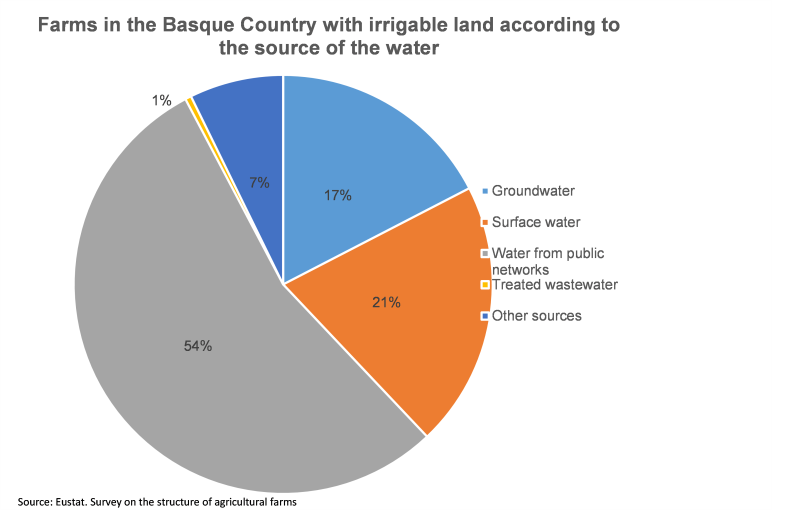
As regards the source of the water used for irrigation, more than half of irrigated holdings (58%) had access to public supply networks or large community irrigation channels, especially in Álava, where 67% of its irrigated holdings were supplied by channels such as those in Zadorra.
Soil management practices
Traditional tillage practices continued to be the most common and were used on 80% of the Basque Country’s arable land
The section on agricultural soil management provides information on tillage techniques and the presence of ground cover on arable land in winter. In the Basque Country, the amount of land on which tillage methods were used in 2023 covered 64,158 hectares, the vast majority of which (94%) were in Álava (60,120 ha), with Bizkaia (2,070 ha) and Gipuzkoa (1,968 ha) having fewer arable areas due to their mountainous and humid geography. Traditional tillage practices (conventional ploughing using a mouldboard or disc plough) continued to be the most common, and were used on 51,539 arable hectares, equivalent to 80% of the Basque Country’s arable land. Minimum tillage or conservation tillage techniques, which avoid deeply turning the soil, were used on 6,568 ha (10% of the land), while direct seeding (zero tillage between harvest and sowing) was used on 6,051 ha (9% of the total).
With regard to winter soil cover, which helps protect the soil from erosion and improves its fertility, 76% of the land was occupied by winter crops (mainly autumn-winter cereals) that cover the soil naturally. 20% spent the winter with bare soil that was completely uncovered, leaving the earth exposed. The remaining land was covered by catch or cover crops (3%), grown specifically to avoid leaving the soil bare in winter after the main harvest, and by plant residues or mulch (2%) spread over the soil.
Lastly, crop rotation was widespread in the Basque Country: in 2023, 92% of the arable land (59,916 ha) was cultivated following a rotation system, whether biennial or multiannual, whereas only 8% (5,410 ha) was still used for single-crop farming with no rotation.
Fruit trees
Apple trees dominated Basque fruit farming: Gipuzkoa accounted for 78% of the land used for this purpose
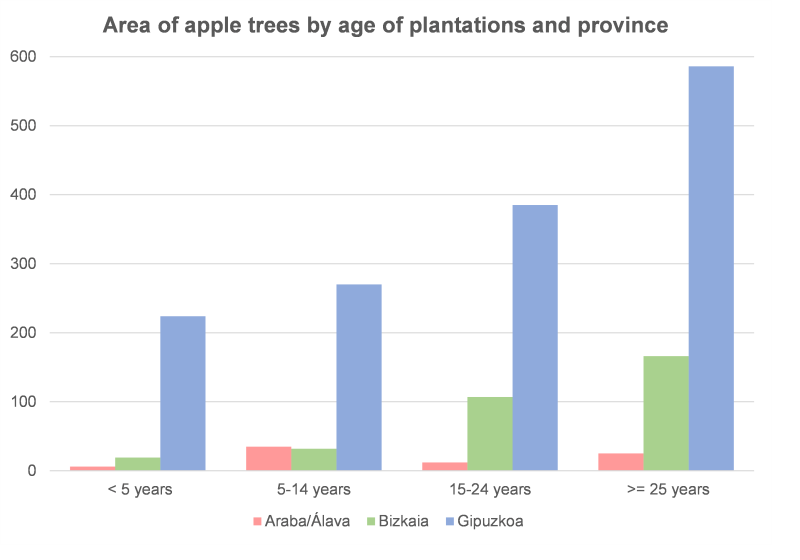
Apple trees, grown primarily for cider, were the main fruit tree in the Basque Country (with the exception of grapevines). In 2023, they covered 1,869 hectares distributed over 2,673 holdings. This volume accounted for 98% of the Basque Country’s pome fruit trees, both in terms of the number of holdings and land area.
Gipuzkoa was by far the leading province when it came to apple orchards: 1,466 ha (78% of the total) spread across 1,579 holdings were located in this province, demonstrating the cultural and economic importance of cider apples in Gipuzkoa. Bizkaia had 324 ha (17% of the total) on 849 holdings, and Álava had just 78 ha (4% of the total) on 245 holdings, as its permanent agriculture is more focused on vineyards.
In terms of evolution, the amount of land used for growing apple trees increased compared to a decade earlier, especially in Gipuzkoa, where traditional apple orchards were updated and new varieties were planted for cider. In fact, 13% of the existing apple trees (approximately 249 ha) were young plants less than 5 years old, a sign of the crop’s continuous renewal. However, there was still a high percentage of veteran apple trees: approximately 42% of apple trees (778 ha) were planted 25 or more years ago, and in many cases they were local varieties of traditional trees. This balance between new plantations and adult orchards reflects efforts to restore and modernise Basque apple orchards, in line with the implementation of the designation of origin and the sector’s efforts to meet demand with local apples. All this combines traditional cider-making with more modern intensive planting techniques. Most orchards had densities of less than 400 trees per hectare, representing 93% of holdings and 89% of the total area used for growing apple trees.
Machinery and equipment
The Basque Country was the Autonomous Region with the highest proportion of holdings that owned tractors (76%), with more than 12,000 agricultural tractors in total
The agricultural equipment fleet in the Basque Country reflected a high degree of mechanisation on holdings. In 2023, 7,985 holdings (76% of the total) had at least one tractor owned exclusively by them, making a total of 12,133 tractors in the Basque Country. The percentage of holdings in the Basque Country with at least one tractor in their possession was the highest of all the autonomous regions, nearly 30 percentage points higher than the national average. In addition to tractors, which form the basis for mechanisation, Basque holdings owned various specialised implements and machinery.
Number of farms, irrigable and irrigated area of the Basque Country by irrigation method according to historical territory. 2023
| | Basque Country | Araba/Álava | Bizkaia | Gipuzkoa |
| | No. Farms | Surface (ha.) | No. Farms | Surface (ha.) | No. Farms | Surface (ha.) | No. Farms | Surface (ha.) |
| Irrigable area | 4.553 | 6.410 | 3.011 | 5.340 | 1.165 | 649 | 376 | 421 |
| | | | | | | | | |
| Irrigable area | 4.520 | 5.697 | 2.978 | 4.653 | 1.165 | 649 | 376 | 395 |
| - - Spraying | 1.169 | 3.148 | 555 | 2.831 | 392 | 79 | 222 | 238 |
| - Located | 2.495 | 2.317 | 1.492 | 1.737 | 872 | 481 | 131 | 98 |
| - - According to gravity | 1.593 | 233 | 1.192 | 85 | 273 | 90 | 128 | 58 |
Date May 29, 2025
Source: Eustat. Survey on the structure of agricultural farms
Within the field of machinery, of particular note was the quantity of harvesters and harvesting machinery owned in the Basque Country, which was well above the Spanish average.
In terms of technological and energy-related equipment, it is worth mentioning that 588 holdings (5.6%) had renewable energy facilities (primarily solar panels).
Furthermore, 1,250 holdings (12% of the total) used some kind of precision farming technique or machinery, such as robotic machinery, machinery for analysing soil through sampling, or variable rate techniques. On large holdings in Álava, it was very common to find self-steering tractors or digital tools for precision farming. Also of note was the high level of technological advancement in dairy farming, both with regard to animal nutrition and control and decision-making on the holding.
Summary
In short, the 2023 Survey on the Structure of Agricultural Holdings paints a picture of Basque agriculture in transition: there were fewer holdings, but they were larger, more technologically advanced and showed a slight recovery in female leadership; and it was a sector that continued to face classic challenges such as generational replacement and the underutilisation of certain resources, but also showed progress in sustainability and modernisation (conservation tillage, incipient product diversification, introduction of technology). These results provide valuable information for guiding agricultural policies in the Basque Country towards competitiveness and sustainability, while balancing the tradition of the Basque countryside with the innovation needed to tackle the future.
Methodological note:
The 2023 Survey on the Structure of Agricultural Holdings is divided into two blocks: one main block detailing the main characteristics, and another additional block on modular variables relating to labour force, irrigation, soil management practices, fruit trees and machinery.
The data refer to the 2023 agricultural year, from 1 October 2022 to 30 September 2023, for variables related to land and as regards livestock numbers, the information was collected with a reference date of 30 September 2023.
The population framework comprises all agricultural and livestock holdings in existence on 30 September 2023, regardless of the natural or legal person acting as holder and the purpose of the agricultural production, provided that they meet one of the following criteria: 1 ha of utilised agricultural area (UAA), 1 ha of arable land, 0.5 ha of UAA used for potatoes, 0.2 ha of UAA used for fresh vegetables and strawberries, 0.2 ha of UAA used for aromatic, medicinal and culinary plants, flowers and ornamental plants, seeds and seedlings or nurseries (outdoor), 0.3 ha of UAA used for fruit trees, berries, walnut trees, citrus fruit trees or other permanent crops (excluding nurseries, vineyards and olive trees), 0.1 ha of UAA used for vineyards, 0.3 ha of UAA used for olive trees, 100 m2 of greenhouses, 100 m2 of cultivated mushrooms, 1 livestock unit (LU) (except equine) or 10 beehives.
The methodology used to collect information was a mixed system of direct collection via a questionnaire and massive use of administrative records, primarily the CAP aid applications file and livestock holding registries.
This operation was carried out in collaboration with the Spanish National Statistics Institute (INE) in the Basque Country, in accordance with the agreement signed by both parties.
For further information:
Eustat - Euskal Estatistika Erakundea/Basque Statistics Institute
C/ Donostia-San Sebastián, 1 01010 Vitoria-Gasteiz
Press Service: servicioprensa@eustat.eus Tel.: 945 01 75 62